Part Four - Changes under way
During the 200 years 1650-1850 the whole way of life changed in Britain.
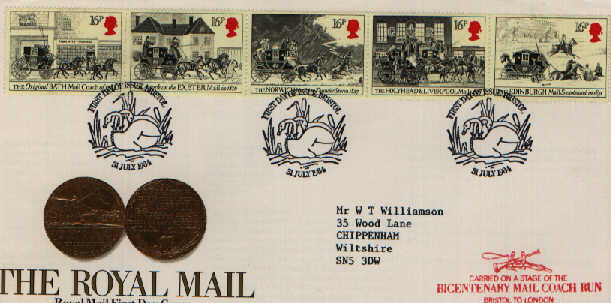
The original Bath Mail Coach

Before 1840 there were various factors which affected the cost of posting a letter. They included:
1 - the distance involved,
2 - the weight,
3 - whether it was a single or a double sheet,
4 - whether there was anything enclosed and
5 - whether it was paid for on despatch or receipt.
So if a letter weighed less than the stated amount, and it was a single sheet, and it was paid for on despatch, and had to go a certain number of miles, then it would cost the minimum rate. Any of these factors being over the rate would double, or increase the cost.
This example from London to Brighton would have cost 8 pence. But the sender had written on the bottom left hand corner 'double' which doubled the cost to 16 pence or one shilling and fourpence. However , the Post Office official noticed that it was more than one ounce in weight, so that doubled the cost again, making it 32 pence (two shillings and eightpence).
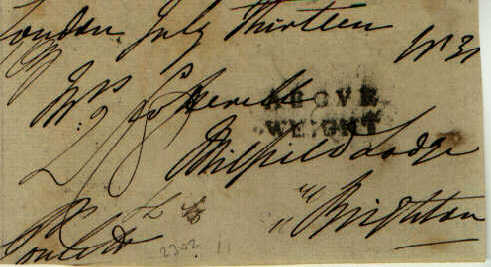
To authorise the change, he applied the stamp 'ABOVE WEIGHT', wrote on the new rate of '2/8' and initialled it.
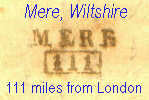
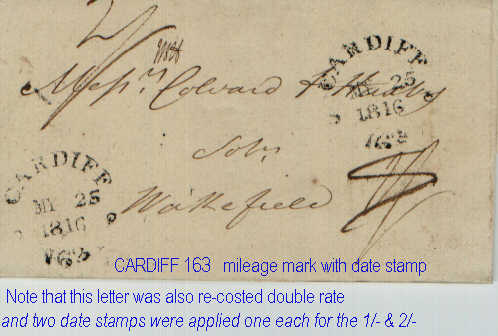
In 1784 new and increased postal charges were introduced which made the distance a letter was carried more important, and the mileage from London began to appear in country postmarks. The mileage was calculated from London, as all the mail had to come through London. These 'mileage marks' stamps varied enormously, as shown by the plain 'MERE 111' and the Cardiff 163, which included the date as well as the mileage.
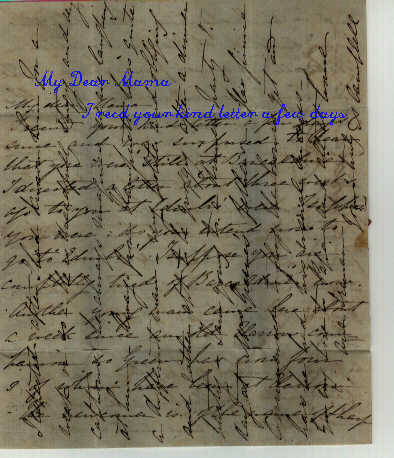
To save on postage they 'crossed' their letters to use only a single sheet. This is an example of a crossed letter
1784 also saw the beginning of the mailcoach era.
This was made possible partly because of the improved roads, as a result of the new surfacing techniques developed by Telford and Macadam.Turnpike Trusts had been set up over the whole country. These were a means by which the cost of improving the road was paid for by interested subscribers, and then when the road was made up, tollgates were erected and tolls collected from the users of the road to recover the costs.
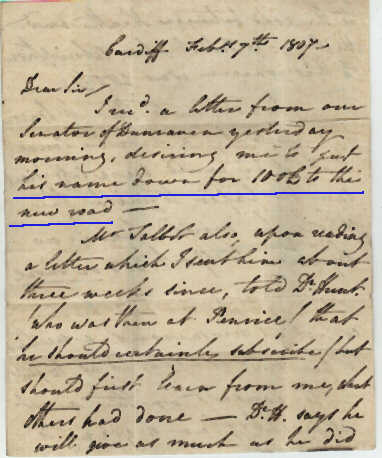
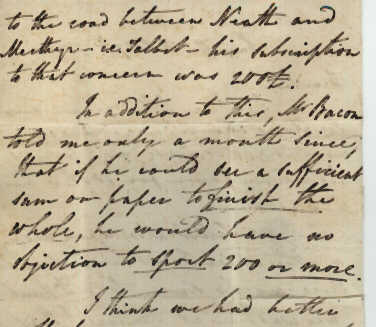
‘In addition to this, Mr. Bacon told me only a month since: that if he could see a sufficient sum on paper to finish the whole, he would have no objection to sport 200 or more.’
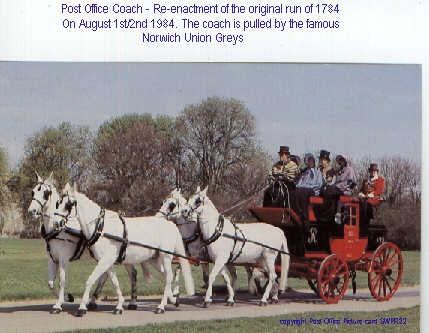
John Palmer (1742-1818) of Bath in Somerset, proved to the Postmaster General that his method of transport was faster and safer. Instead of using the postboys on horseback, he chartered a light-weight coach drawn by four horses, which completed the journey from Bristol to London in sixteen hours.
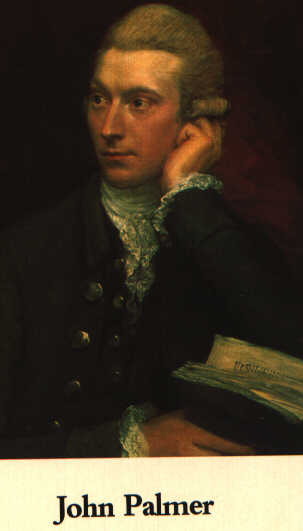
The system accelerated the delivery of letters between Bristol and London, by one day and so was adopted. It expanded very quickly.
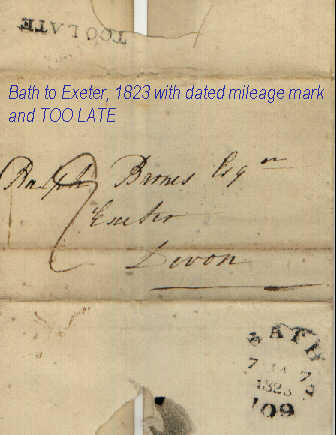
They kept to a strict timetable, as shown from this letter which arrived too late.
The 16th century Kings Arms Inn in Melksham on the Bath road, 95 miles from London was a coaching inn. Melksham is a very old town. There has been a settlement here since Anglo-Saxon times. It was listed in the Domesday Book as belonging to Earl Harold of Wessex.
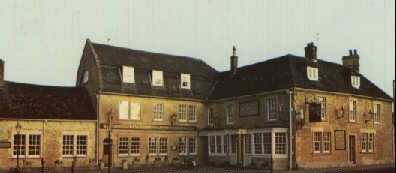
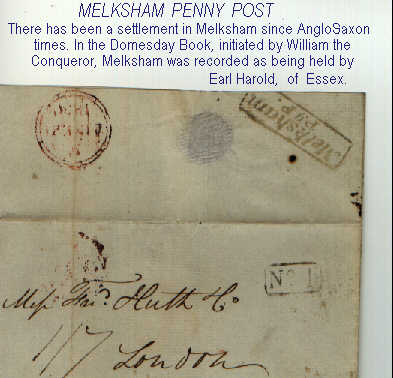
The coaching inns in London were in competition with one another. The Swan with Two Necks, became the largest of its kind in London.
 Click for larger image.
Of the 28 mail coaches which left London every evening, half were horsed at this inn. As a matter of interest, it has been suggested that the name of this coaching Inn was originally the Swan with Two Nicks, this being one of the identifying marks made on the bill of a swan to mark ownership in the annual ceremony of 'Swan-Upping' on the River Thames.
This letter  is dated
Nov 5th 1798 and in it the writer says;
is dated
Nov 5th 1798 and in it the writer says;
'I sent your bill and my bills on the late Mr. Broadhurst in a parcel to the SWAN WITH TWO NECKS in
Lad Lane last night to go by this mornings coach to Derby so that you will receive them tomorrow evening.'
The Mails were reliable and unless there were exceptional weather conditions, kept to their time schedules. Many Mails were so punctual that country clocks were set by their daily arrival.
Another of the great coaching Inns based in London was the 'Bull and Mouth' in St. Martins-le-Grand.
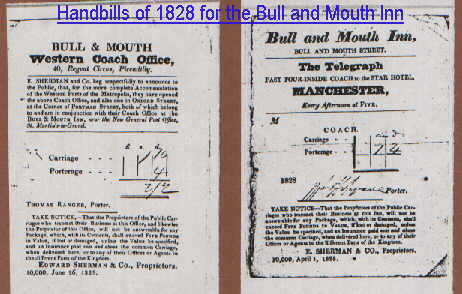
BULL & MOUTH
Western Coach Office,
40, Regent Circus, Piccadilly.
E. SHERMAN and Co beg respectfully to announce to the Public, that , for the more complete Accommodation of the
Western Parts of the Metropolis, they have opened the above Coach Office, and also one in OXFORD STREET, at the
corner of PORTMAN STREET,both of which belong to and are in conjunction with their Coach Office at the BULL & MOUTH
Inn, near the New General Post Office at St. Martins - le- Grand.
Carriage - - - 1/ 10/ 0
Porterage- - - 4 /2 / 2
Thomas Ranger, Porter
TAKE NOTICE, - that the Proprietors of the Public Car-riages who transact their Business at this Office, and likewise the Proprietor of this Office, will not be answerable for any Package, which with its Contents, shall exceed FIVE POUNDS in value, if lost or damaged, unless the Value be specified and an Insurance paid over and above the common Carriage, when delivered here, or to any of their Offices or Agents in the different Parts of the Kingdom.
EDWARD SHERMAN & CO., Proprietors
10,000 June 26, 1828
Bull and Mouth Inn,
BULL AND MOUTH STREET,
The Telegraph
FAST FOUR-INSIDE COACH to the STAR HOTEL
MANCHESTER
Every Afternoon at FIVE.
M
C O A C H
Carriage - - -
Porterage - - - 7 4
1828
Wm H Tyrone...... Porter
TAKE NOTICE-That the Proprietors of the Public Car-riage who transact their Business at this Inn, will not be answerable for any Package, which, with its Contents, shall exceed FIVE POUNDS in value, if lost or damaged, unless the Value be specified and an Insurance paid over and above the common Carriage, when delivered here, or to any of their Offices or Agents in the different Parts of the Kingdom.
EDWARD SHERMAN & CO., Proprietors
10,000 April 1, 1828
 .
.
Most of the letters in our collection come from business houses, but of course there were many private letters sent. Much of this type of correspondence has naturally been destroyed — after all, how many people keep personal letters?
We have been fortunate to obtain letters like this one of 20th September 1838 from a man to his sister.
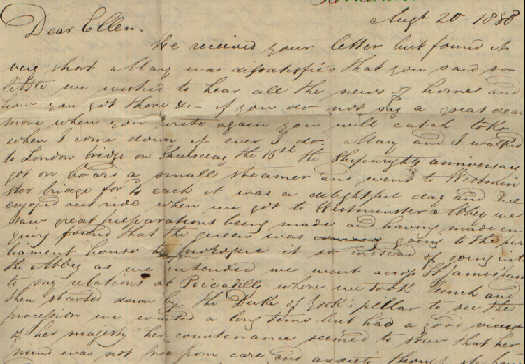
Dear Ellen,
We received your letter but found it very short. Mary was dissatisfied that you said so little, we wished to
hear all the news of home and how you got there etc. If you do not say a great deal more when you write again
you will catch toko when I come down, if ever I do'. . . . .
(Note : 'toko' was the current slang for 'a chastisement or a thrashing')
...Mary and I walked to London Bridge on Thursday the 16th, the Shipwrights anniversary, got on board a small steamer and went to Westminster Bridge for 4d each, it was a delightful day and we enjoyed our ride. When we got to Westminster Abbey, we saw great preparations being made and having made enquiry found out that the Queen was going to the Parliament House to prorogue it, so instead of going into the Abbey as we intended, we went across St. James' Park to my relations at Piccadilly where we took lunch and then started down by the Duke of York's Pillar to see the procession.
We walked a long time but had a good view of her majesty. Her countenance seemed to show that her mind was not free from care and anxiety though she bowed and put on a smiling look. May God Almighty bless her and give her a right judgement in all things.'
(Note : Parliament is 'prorogued' when it is discontinued, between sessions, but not dissolved - which involves re-election of members.
the letter continues....
The carriages and trappings of the horses were very handsome, several foreign ambassadors were present. We saw old Sir Francis Burden on horseback like an old farmer. Mary was pleased to see our Gracious little Queen. When the procession had passed we returned to Piccadilly, took dinner and being tired, lolled on a sofa till tea time. About six oclock started for home, walked all the way as we could not fall in with an Omnibus - reached home about 9 oclock. Met Mr and Mrs Harlow in the park, they went on to the Zoological gardens in Regent's Park.
He finishes up with this paragraph
Mary's health is certainly better. The blister on the back of her neck did her head good but she suffered much with it, her neck was much swollen and the glands of her neck very painful. I hope she will get stronger.'
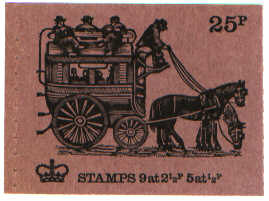
The Omnibus he refers to would have been a public transport horse-drawn carriage, as shown on this British postage stamp booklet. a London Horse-drawn ombibus of the 1850's
 Part Five, Towards Penny Postage Part Five, Towards Penny Postage
|